

A police pension is widely considered one of the most valuable retirement benefits in the UK public sector — but understanding how much you’ll actually receive, what you pay in, and how to check your figures can feel confusing with three different schemes still in operation. This guide breaks down how the police pension works, how much you can expect to receive, how to use a police pension calculator, and what’s changing in 2026.
What Is a Police Pension?
A police pension is a defined benefit pension scheme for serving and retired police officers in England, Wales, Scotland, and Northern Ireland. It guarantees a regular income for life once you retire, based on your salary and years of service, rather than depending on investment performance like a standard workplace pension. Most officers today build benefits under the 2015 scheme, a career-average arrangement that replaced the older final-salary schemes. For the full official breakdown of entitlements, see the official police pension scheme guide on GOV.UK.
The Three Police Pension Schemes Explained
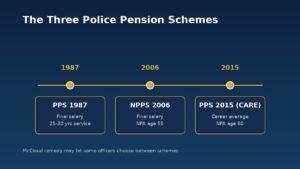
Depending on when you joined the force, you could be a member of one of three different schemes — or a mix of more than one, due to transitional protections.
1987 Scheme (PPS 1987)
Open to new members until April 2006, this final-salary scheme calculates your pension using your salary at (or near) retirement and your years of service. Officers could retire after 25 years with a reduced pension, or after 30 years with a full pension, regardless of age.
2006 Scheme (NPPS 2006)
Open between April 2006 and April 2015, this scheme is also final-salary based but set the normal pension age at 55, rather than tying full pension eligibility purely to years served.
2015 Scheme (PPS 2015 / CARE)
Since April 2015, nearly all active officers build benefits under the Career Average Revalued Earnings (CARE) scheme. Instead of using your final salary, it adds up 1/55.3 of your pensionable pay for every year you serve, and revalues that banked amount each year in line with CPI inflation plus 1.25%. The normal pension age under this scheme is 60, though you can draw a reduced pension from age 55.
Because of a legal ruling known as the McCloud remedy, many officers who were moved into the 2015 scheme during the transition now have a choice between 2015 scheme benefits and their legacy scheme benefits for the affected years — worth checking if this applies to your service record.
How Much Pension Does a Police Officer Get?
Your eventual pension depends heavily on your rank, salary, and years of service. As a general guide:
| Career profile | Estimated annual pension (before tax) |
| Constable, 30 years’ service, PPS 2015 | Roughly £20,000–£25,000 |
| Constable/Sergeant, 30–35 years, mixed scheme | Roughly £25,000–£35,000 |
| Inspector or Superintendent, full career | Roughly £40,000–£60,000+ |
Under the 2015 scheme, the formula is straightforward: your annual pension equals your pensionable pay divided by 55.3, multiplied by your years of service, with each year’s accrual separately uprated for inflation. On a career-average salary of £45,000 over 30 years, that works out to a pension in the region of £24,000 a year, before any lump sum is taken.
Police Pension Contributions: What You Pay
Police pension contributions are taken directly from your pensionable pay — which generally includes basic salary and permanent allowances, but excludes overtime. Contribution rates are tiered by salary band and typically fall between roughly 12% and 13.5% of pensionable pay for most officers, though rates are reviewed periodically by the Home Office. Because contributions qualify for income tax relief, the actual reduction in take-home pay is noticeably lower than the headline percentage.
How to Use a Police Pension Calculator
A police pension calculator lets you estimate your future annual income based on your current pensionable pay, years of service, and expected retirement age. To get a realistic figure:
- Gather your current pensionable salary and total years of service (including any transferred-in service).
- Confirm which scheme(s) you’ve been a member of, since 1987, 2006, and 2015 benefits are calculated differently.
- Enter your expected retirement age, since taking your pension before your scheme’s normal pension age usually applies an actuarial reduction.
- Compare the estimate against your official annual benefit statement for accuracy.
For a broader view of your total retirement income — including your entitlement outside of the police scheme — it’s also worth running your numbers through a UK State Pension calculator, since most officers will receive the State Pension in addition to their police pension.
Police Pension Login & the XPS Police Pensions App
Most police forces in England and Wales have their pension scheme administered by XPS Administration, one of the largest pension administrators for police, fire, and local authority schemes. Through XPS’s Member Self-Service (MSS) portal, officers can log in to:
- View their latest annual benefit statement
- Run benefit projections for different retirement ages
- Update personal and beneficiary details
- Track McCloud remedy choices, where applicable
If you’re unsure which administrator handles your force’s pension, check with your force’s HR or pensions team, since login portal names and links can vary slightly by force even though most now run on the XPS system.
Police Pension Increase (2026 Update)
Police pensions already in payment rise each April in line with the Consumer Prices Index (CPI) from the previous September, under long-standing pensions increase legislation. For 2026, pensions in payment are set to rise by 3.8%, reflecting the CPI figure confirmed for the year to September 2025. This increase is applied automatically — you don’t need to apply for it — though officers whose pension has been in payment for less than 12 months may see a pro-rated uplift.
Is the Police Pension Any Good?
By UK standards, yes — the police pension is consistently ranked among the most generous defined benefit schemes still available. A large share of the cost is met by the employer (police force) rather than the officer, the 2015 scheme includes built-in inflation protection, and officers can access their pension from age 55, well ahead of the rising State Pension age. Very few private-sector employees today have access to a comparable guaranteed-income scheme.
Frequently Asked Questions
How much pension does a policeman get?
It depends on rank, salary, and years of service, but a typical constable retiring after around 30 years under the 2015 scheme can expect somewhere between £20,000 and £25,000 a year before tax, while longer careers or higher ranks can produce £40,000 or more.
Is the police pension any good?
Yes. It’s widely regarded as one of the best available UK pensions, thanks to guaranteed lifetime income, inflation-linked increases, and a retirement age well below the standard State Pension age.
Will the police pension change in 2026?
The main confirmed change for 2026 is the annual CPI-linked increase of 3.8% applied to pensions already in payment from April. Officers affected by the McCloud remedy may also see ongoing adjustments as remediation is finalised.
How long do you have to work for the police to get a pension?
Most police pension schemes require a minimum qualifying period, generally around two years of service, before you’re entitled to preserved pension benefits rather than a refund of contributions. Check your specific scheme rules, since this can vary based on when you joined.
Conclusion
The police pension remains one of the strongest retirement benefits available in the UK, but the amount you’ll actually receive depends on which scheme (or schemes) you’ve been a member of, your salary history, and your years of service. Using an official police pension calculator, checking your annual benefit statement through your XPS login, and factoring in your State Pension entitlement will give you the clearest possible picture of your total retirement income.

Waqar Khan is the founder of PensionCalculator.online, a platform dedicated to helping individuals understand pension systems through free online calculators and easy-to-read educational content. His mission is to simplify retirement planning so that anyone can estimate their pension benefits, understand pension rules, and make more informed financial decisions.