
Plug the same pension pot, contribution rate, and retirement age into three different UK pension calculators and you’ll often get three different projected incomes. That’s not a sign that one of them is broken — it’s a sign that pension calculators are built on assumptions, not certainties, and different providers make different assumptions.
This guide explains exactly how accurate UK pension calculators really are, what they get right, what they systematically leave out, and how to read a projection without being misled by its false precision.
The Honest Starting Point: No Calculator Guarantees a Number
Nearly every reputable UK pension calculator carries some version of the same disclaimer. Vanguard’s tool states plainly: “Our pension calculator is a guide only. It’s not guaranteed you’ll get that amount.” Standard Life’s calculator similarly warns that “a pension is a long-term investment — its value can go down as well as up and could be worth less than was paid in.”
This isn’t legal boilerplate to ignore — it’s the single most important fact about how these tools work. A UK pension calculator for a defined-contribution pot is a projection based on assumptions, not a promise, and its accuracy is entirely bound by how reasonable those assumptions turn out to be.
What Drives the Accuracy of a DC Pension Projection
Investment Growth Assumptions
Every workplace or personal pension calculator has to assume a future rate of investment return, and this single number has an outsized effect on the final projection. Growth rates used in these calculators are examples only — actual growth rates will depend on how your investments perform and could be higher or lower.
Because pension growth compounds over decades, even a modest difference in the assumed rate (say, 4% vs. 6%) can produce wildly different projected pots for someone 20–30 years from retirement.
Inflation Assumptions
Most calculators also bake in an assumed inflation rate to show your pot’s value in “today’s money” rather than future nominal terms. The calculation includes an assumed rate of inflation, but actual inflation could be higher or lower, which will impact the future value of your savings and investments. If real-world inflation runs hotter than the assumption, your pot’s actual purchasing power at retirement will be lower than the calculator suggested.
Fees and Charges
This is a detail that materially affects accuracy but is easy to overlook. Some calculators explicitly build in ongoing charges: “we assume you’re paying an annual account fee of 0.15% and an average investment fund charge of 0.20%… these fees have been deducted from your estimated pension pot”. Others don’t factor in fees at all, which means the same pot size and contribution rate can generate a noticeably higher projected result on a calculator that ignores charges compared to one that models them properly.
Tax-Free Lump Sum and Drawdown Assumptions
Many calculators make a specific assumption about how you’ll take your pension. For example, one major provider’s tool assumes that when you start taking money from your pension, you’ll take 25% as a tax-free lump sum, with your estimated pension income reflecting this deduction and based on withdrawing from the remaining pot at 4% per year. If your actual retirement strategy differs — taking less tax-free cash, or withdrawing at a different rate — the projected income figure won’t match your real outcome.
What UK Pension Calculators Commonly Leave Out
Tax Charges
The calculator doesn’t take into account tax charges which may apply when you withdraw your pension at retirement, or on any contributions that exceed your allowances. This means the headline “pot size” or “income” figure is often a gross, pre-tax number — your actual take-home retirement income will likely be lower once income tax is applied.
Annual and Lifetime Allowances
Some calculators explicitly state they have not built in annual or lifetime allowances set by HMRC into their figures. If your contributions or growth push you toward these thresholds, the calculator’s projection won’t reflect any tax penalty that could apply.
Additional Benefits and Entitlements
Before trusting a calculator’s output, it’s worth checking your specific scheme for extras that generic tools won’t know about. Before using a pension calculator, you should check any additional benefits you may have with your pension provider, as these may alter the results — and separately, it’s worth confirming whether other means-tested benefits, such as housing benefit or income support, could interact with your retirement income in ways a standard calculator won’t model.
Your Actual National Insurance Record (for State Pension estimates)
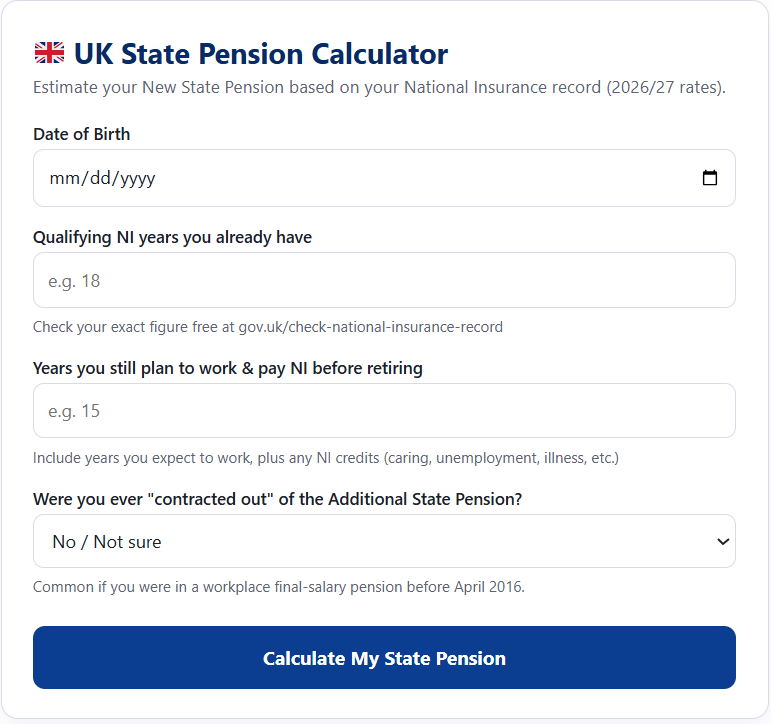
Calculators that include the State Pension in a combined forecast are only as accurate as the NI record data behind them. If you started making contributions after 2016, you’ll typically need 35 full qualifying years of National Insurance contributions to receive the full State Pension. A calculator that assumes a full NI record without checking yours can overstate your State Pension component significantly. You can check your actual National Insurance record on GOV.UK before relying on a State Pension estimate.
Defined Benefit vs. Defined Contribution: Different Accuracy Profiles
It’s worth separating out two very different types of “pension calculator” that get lumped together:
| Pension Type | Accuracy Profile |
| Defined Contribution (workplace/personal pot) | Genuinely uncertain — result depends on market performance, contributions, and assumptions that can’t be known in advance |
| Defined Benefit (final salary/career average) | Far more precise — the payout follows a fixed formula tied to salary and years of scheme membership, not investment markets |
| State Pension | Precise if based on your actual NI record; inaccurate if the calculator assumes a generic full record |
A DB pension calculator, when fed accurate scheme details, is meaningfully more “accurate” in the traditional sense than a DC calculator — because it’s not projecting an uncertain future, it’s applying a known formula.
How MoneyHelper’s Combined Forecast Approach Improves Accuracy
Rather than modeling just one pension in isolation, some tools try to build a fuller picture. MoneyHelper’s pension calculator produces a forecast including income from defined benefit and defined contribution pensions, as well as your State Pension, and lets you alter your retirement age to see how that affects your income, or see how increased contributions or a smaller tax-free lump sum change your yearly pension. Combining all three income sources into one forecast tends to produce a more realistic overall retirement picture than checking each pension in isolation on separate single-purpose calculators.
How to Read a UK Pension Calculator Result Responsibly
- Check what growth rate and inflation assumption the calculator is using. If it’s not disclosed, be cautious about trusting the headline number.
- Check whether fees are included. A projection that ignores charges will look rosier than reality.
- Check whether the figure is gross or net of tax. Most are gross — mentally discount the number accordingly.
- Treat DC projections as a range, not a point estimate. Run the calculator with a conservative growth assumption and an optimistic one to see the spread.
- Treat DB and State Pension figures with more confidence, since they’re formula-based rather than market-dependent — but still verify against your actual scheme statement or NI record.
Common Mistakes That Reduce Accuracy Further
- Entering current pot value without accounting for multiple old pensions. There are billions of pounds in lost pensions in the UK waiting to be claimed — if you have old workplace pensions you’ve forgotten about, your calculator input will understate your true total pot.
- Not updating contributions after a pay rise. If you have a workplace pension and your salary increases, your own monthly contributions and your employer’s contribution will typically increase automatically since they’re calculated as a percentage of salary — recalculate periodically rather than relying on a projection made years earlier with outdated figures.
- Assuming the calculator accounts for early access restrictions. You can’t usually access a personal pension until age 55 (rising to 57 from 2028) — plans that assume earlier access will need adjusting.
- Using a calculator not built for your circumstances. Some tools explicitly state they’re not suitable for people within a year of, or already receiving, their Single-Tier State Pension — using the wrong tool for your life stage produces meaningless results.
Frequently Asked Questions
Are UK pension calculators reliable enough to plan retirement around?
They’re reliable for directional planning — showing whether you’re broadly on track — but not precise enough to rely on for an exact income figure, especially for defined-contribution pensions where market performance is unknowable in advance.
Why do different pension calculators give me different numbers for the same pot?
Because each uses its own assumptions for investment growth, inflation, fees, and withdrawal strategy. Small differences in any of these assumptions compound significantly over a long time horizon.
Do UK pension calculators include tax?
Most show gross figures and explicitly state they don’t account for tax charges on withdrawal or on contributions exceeding HMRC allowances. Treat the number as pre-tax.
Is a defined benefit pension calculator more accurate than a defined contribution one?
Generally yes — a DB pension follows a fixed formula tied to salary and scheme membership years, while a DC pension’s value depends on unpredictable investment performance.
How often should I re-run my pension calculator?
At least once a year, or after any pay rise, job change, or significant change in your pension contributions, since your inputs (and the assumptions behind them) can shift meaningfully over time.
Final Takeaway
UK pension calculators are useful for one specific job: showing you roughly whether you’re on track, and what levers (contributions, retirement age, growth) move the needle most. They are not precise prediction tools, particularly for defined-contribution pensions, because they rely on assumptions about growth, inflation, and fees that can’t be known in advance. Use them to guide decisions, check what assumptions they’re built on, and confirm anything that matters with your actual pension provider or a qualified financial adviser.

Waqar Khan is the founder of PensionCalculator.online, a platform dedicated to helping individuals understand pension systems through free online calculators and easy-to-read educational content. His mission is to simplify retirement planning so that anyone can estimate their pension benefits, understand pension rules, and make more informed financial decisions.